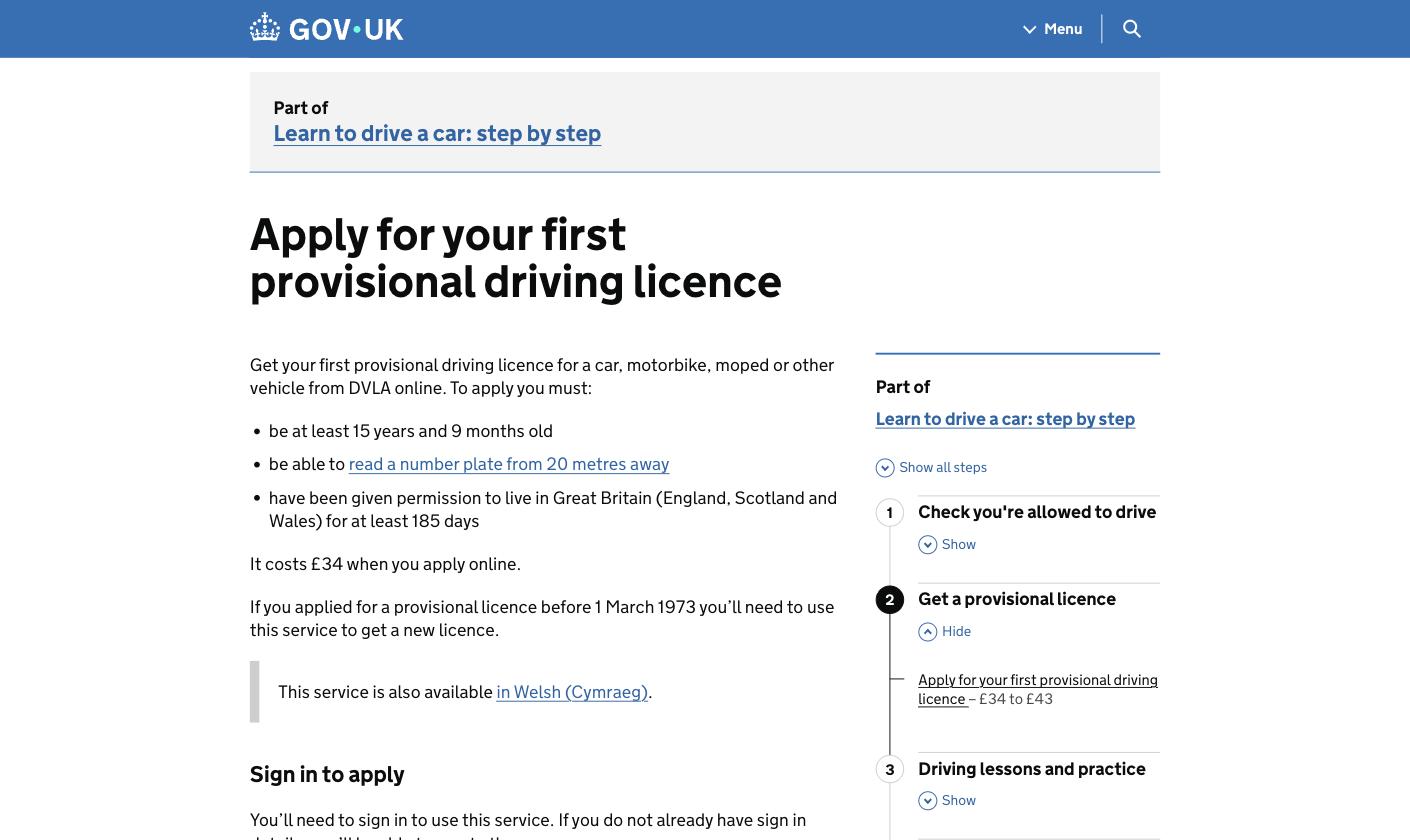
The design principles and the service manual are public. The driving-licence page states its £34 fee before it asks anyone to sign in. Each choice on the page can be traced to a published rule.
The task outranks the brand
The page in the figure is headed “Apply for your first provisional driving licence” and opens “Get your first provisional driving licence for a car, motorbike, moped or other vehicle from DVLA online.” The service names the task and the issuing agency in its first sentence, and never describes the department at all.
Headings name real actions
The step-by-step panel in the figure has three headings: “Check you’re allowed to drive”, “Get a provisional licence” and “Driving lessons and practice”. Each one is phrased as the thing the visitor came to do rather than the name of a government function.
Patterns follow observed behavior
The first of the eleven government design principles is “Start with user needs”, glossed there as: “Service design starts with identifying user needs. If you don’t know what the user needs are, you won’t build the right thing.” The service manual lists conducting user research among the requirements for designing a good service.
Inclusion changes the artifact
Principle six is “This is for everyone”, and the service manual states that “a good service is inclusive so that everyone who needs to can use it as easily as possible.” In the figure that shows up as “This service is also available in Welsh (Cymraeg)”, set inline in the body copy instead of a footer.
Reuse is governed, not automatic
Principle nine is “Be consistent, not uniform”. The manual explains that a good service “uses familiar design conventions to help people use it easily”. It names four things that should hold steady: visual styles and data formats, then interaction patterns and language.
The system can explain itself
Principle ten is “Make things open: it makes things better”, and the principles are published at a public URL alongside the service manual. The reasoning behind the page is public and open to argument.
The sources behind this study: The government design principles and The service manual on designing government services.