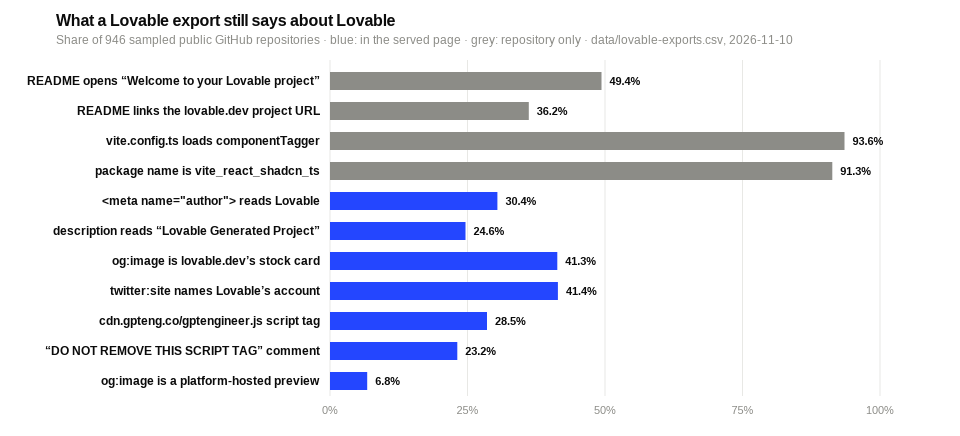
Lovable writes its own name into an exported project in at least ten places. We read four files from each of 946 sampled repositories and counted the defaults that were still there. The build configuration keeps the platform's hook in nearly every repository and the page head keeps its name in most.
The sample was chosen on a dependency rather than on the markers
A repository entered the sample because its root package.json names lovable-tagger, the Vite plugin Lovable ships to mark components for its visual editor. The npm registry first published that package on October 25 2024. The defaults were then read from other files at the default branch, which keeps the count independent of the selection.
The head of the page names the platform four ways
The scaffold writes an author meta tag that reads Lovable and a description that reads Lovable Generated Project. It also points og:image at a stock card hosted at lovable.dev and sets twitter:site to the platform's own account. In the sample 591 repositories keep at least one of these in index.html, which is 62.5 percent.
Share the link and Lovable's card appears
The stock og:image survives in 41.3 percent of repositories and the twitter:site handle in 41.4 percent. A link to such a site posted on Slack or X unfurls with Lovable's artwork rather than the product's. The newer scaffold replaces the stock card with a screenshot of the project hosted on the platform's storage, which 64 repositories carry.
A script tag that asks not to be removed
Exports from early 2025 load gptengineer.js from cdn.gpteng.co, with an HTML comment above it that reads IMPORTANT: DO NOT REMOVE THIS SCRIPT TAG OR THIS VERY COMMENT! Repositories created between February and May 2025 still carry the tag in 87.5 percent of cases. Four repositories deleted the tag and kept the comment.
The scaffold stopped emitting the script in June 2025
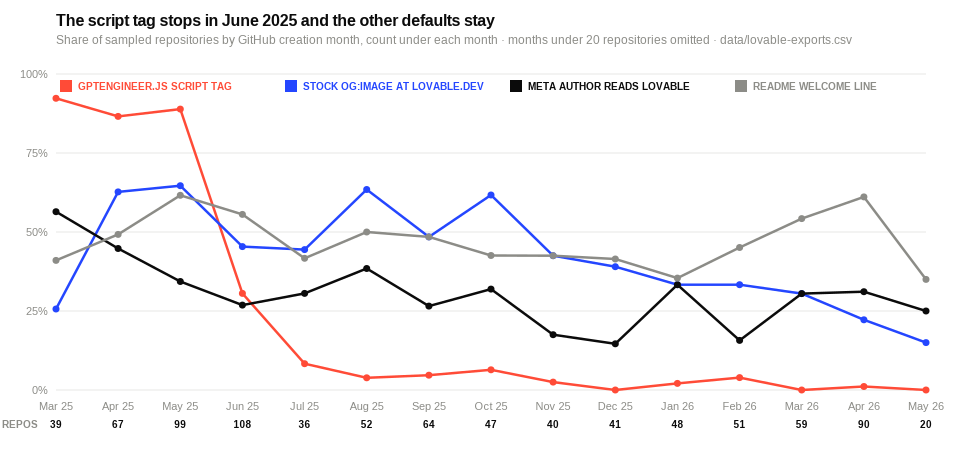
The share of repositories carrying the script falls from 89 percent for May 2025 creations to 31 percent for June and 8 percent for July. The warning comment disappears in the same month, which places the change in the scaffold rather than in owner behaviour. A page that still loads the script was scaffolded before the summer of 2025.
The build configuration is almost never touched
The Vite config still imports componentTagger in 93.6 percent of repositories and the package is still named vite_react_shadcn_ts in 91.3 percent. The README still opens with Welcome to your Lovable project in 49.4 percent and still links the lovable.dev project page in 36.2 percent. The files a visitor never sees are the ones least often edited.
Thirty-four pages are titled Lovable App
The title tag reads Lovable App in 34 repositories and matches the repository name in 123. A browser tab that reads Lovable App was never named by anyone.
What a sample of a search index cannot say
GitHub code search returns at most 1,000 hits per query and three orderings of one query pooled to 951 distinct repositories. Public repositories that export a Lovable project are not the population of Lovable sites, and a page served from lovable.app may differ from the index.html in the repository. Seventeen repositories predate 2025 and were created before the code now in them, which is why creation month dates the repository rather than the scaffold.
The sources behind this study: the GitHub code search the sample was drawn from and the lovable-tagger package on npm.