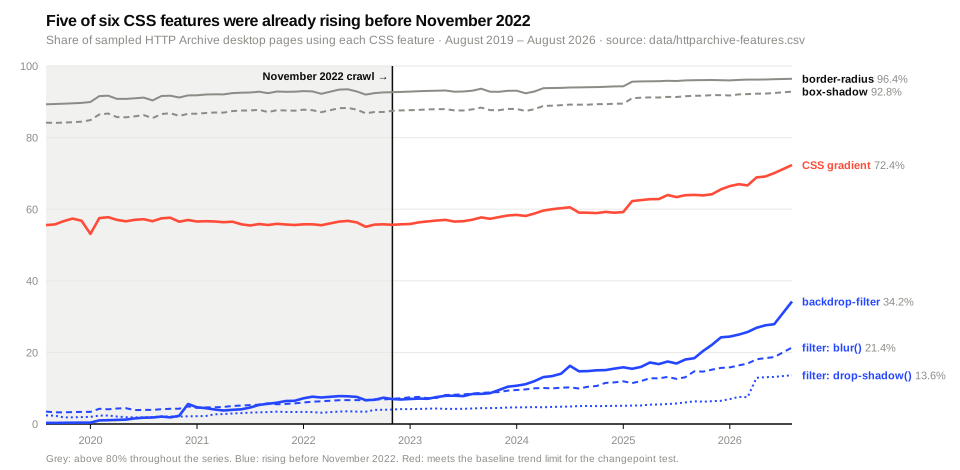
Rounded corners appeared on 92.69 percent of pages in the November 2022 desktop crawl and box shadows on 87.49 percent. CSS gradients passed our growth threshold in April 2024. These counts do not establish whether AI caused the changes.
We counted six properties associated with our visual tells
We selected six CSS properties associated with the design patterns in our two August 16 articles. These include border-radius for rounded cards and backdrop-filter for frosted glass. The count records property use without showing the resulting design.
Rounded corners and box shadows were already common
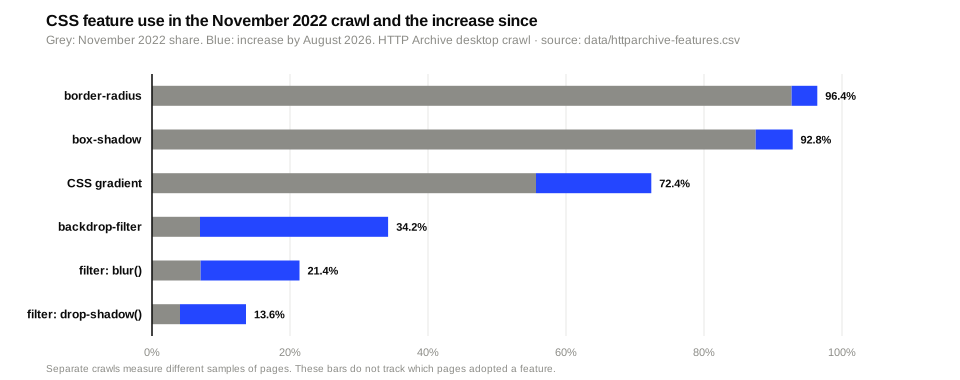
In the November 2022 desktop crawl border-radius appeared on 92.69 percent of pages and box-shadow on 87.49 percent. By August 2026 those shares were 96.42 and 92.85 percent. Their prevalence at launch makes presence alone a poor indicator of AI authorship.
CSS gradients passed the growth threshold in April 2024
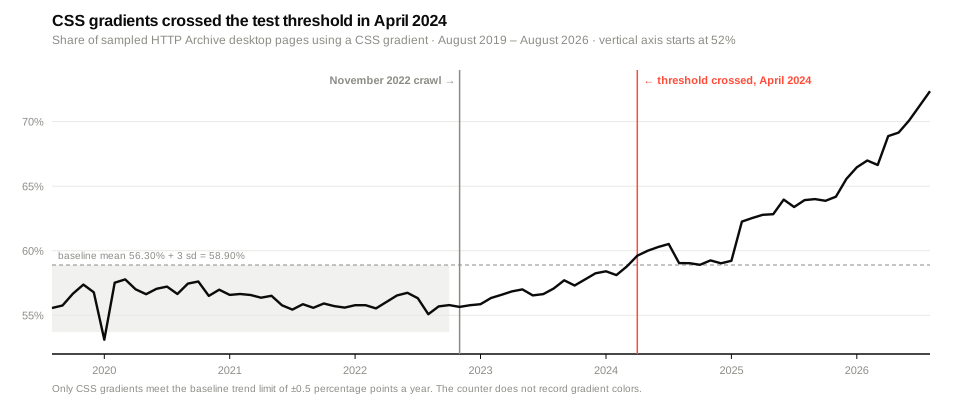
CSS gradients appeared on 55.65 percent of pages in the November 2022 crawl. The 38 earlier crawls averaged 56.30 percent with a standard deviation of 0.87 percentage points. Usage first exceeded the 58.90 percent test threshold in April 2024 and reached 72.36 percent by August 2026.
The growth date depends on the test settings
Only gradients meet our baseline rule of less than half a percentage point of annual change in either direction. Four of the five tested baseline end dates give April 2024; extending the baseline to June 2023 gives March 2024. Thresholds of two and four standard deviations give December 2023 and May 2024 respectively, while all tested run lengths give April 2024 at three standard deviations.
Backdrop-filter usage was rising before ChatGPT
Backdrop-filter went from 6.96 percent in the November 2022 crawl to 34.23 percent in August 2026. Its baseline trend was an increase of 2.73 percentage points a year. Blur and drop-shadow were also rising before launch at 1.18 and 0.65 points a year respectively.
The detected builder count cannot measure AI's contribution
The technology dataset records 13,788 origins across four AI builders alongside a desktop crawl of 11,276,118 pages in August 2026. Dividing these counts gives 0.122 percent. Origins and pages are different units and the detectors miss AI-built sites, so this ratio cannot bound AI's contribution to CSS usage.
April 2022 fails the crawl-quality check
We exclude a crawl when a control counter reads more than five percentage points below its median. April 2022 is the only crawl that fails this rule. All four control counters fall together that month, suggesting a problem with the crawl.
Control counters still vary after the exclusion
After excluding April 2022 the four control counters vary by up to 2.30 percentage points across seven years. The August 2026 mobile and desktop crawls differ by at most 0.59 points on the six properties. Chrome's two backdrop-filter counters differ by at most 0.124 points across 20 overlapping crawls.
The count does not show how often a page uses a property
A page enters a counter if it uses the property at least once. The data does not show how many gradients appear on a page or which properties occur together. It also does not record gradient colors or identify AI authorship.
We no longer treat rounded corners or soft shadows as evidence on their own
We have marked both entries as retired presence tests in the tell index. The gradient entry records April 2024 as the growth date under the stated rule. It does not establish a date for AI adoption or for purple gradients specifically.